Ah, scissors! Teaching your child to use scissors can be tricky - especially since there is a safety component and potential for them to injure themselves. You may be teaching your child to use scissors, but something is just not clicking. This could be anything from your child having difficulty figuring out how to put their fingers into the scissors, how to hold the paper they are cutting, how to open the scissors after successfully closing them to snip, and more!
Scissor Skills
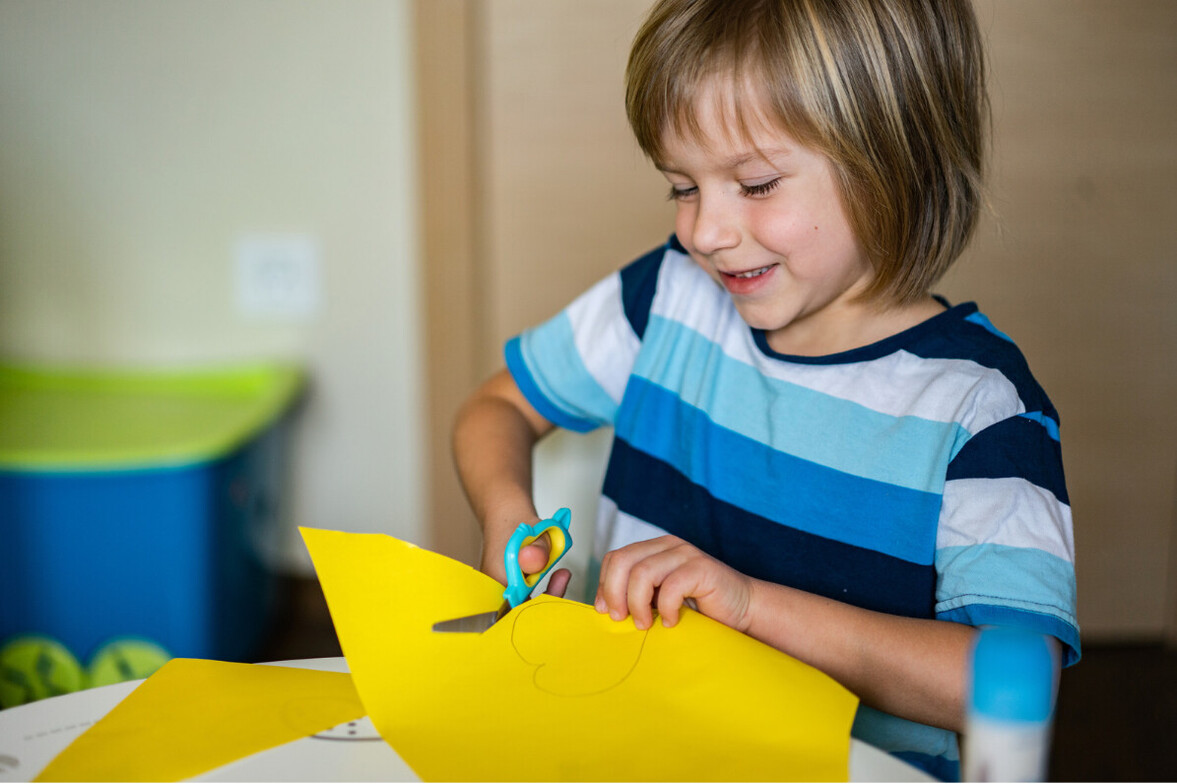
Cutting with scissors is a two-handed skill. One hand opens and closes the scissors while the other hand (or “helper hand”) holds and turns the paper. This teamwork between hands is called bilateral coordination, and it's often the missing piece when cutting looks choppy.
Kids usually learn cutting in this order: snipping paper around age 2 to 3, cutting across a strip of paper around 3, cutting on a straight line around 4, cutting a circle around 4 to 5, and cutting shapes with corners, like a square, around 5 to 6.
At the table, you might notice the thumb pointing down instead of up, the elbow flaring out to the side, or the helper hand letting the paper flop. A thumb-down grip usually needs a cue, while a floppy helper hand means both hands need practice working together.
Try this:
- Use the cue "thumbs up" and put a small sticker on the thumb side of the scissors as a reminder.
- Start with cardstock or index cards. Thicker paper holds its shape and is easier to cut.
- Snip playdough snakes or straws before moving to paper.
- Draw thick, bold cutting lines and keep them shorter than you think you need (start with 1” lines on the edge of the paper)
- You can hold the paper for your child while they are learning to open and close their scissors
How an Occupational Therapist Helps
An OT figures out WHY a skill is hard, not only which skill is hard. Two kids can struggle with cutting for very different reasons. One might have low hand strength, while another might have trouble using both hands together or keeping their eyes on the line.
At Empower Kids OT, I start with an evaluation using standardized assessments, along with screening for visual motor skills and vision. From there, we build a plan together around your child's goals and your homeschool routine.
Sessions happen privately in your home or in a group format at your co-op, which is a natural fit for homeschool families. We practice with your materials, and you learn strategies to use all week. You know your child best. My job is to help you understand the “why” behind each skill and give you a clear next step.
If you're in Central New York and want to talk through what you're seeing at your table this fall, book a free 15-minute consultation at www.empowerkids-ot.com.
Disclaimer: This article is for educational purposes only and is not medical advice. Reading it does not establish a therapeutic relationship with Empower Kids OT. Every child is different, so talk with your child's doctor or a licensed occupational therapist about your child's specific needs.