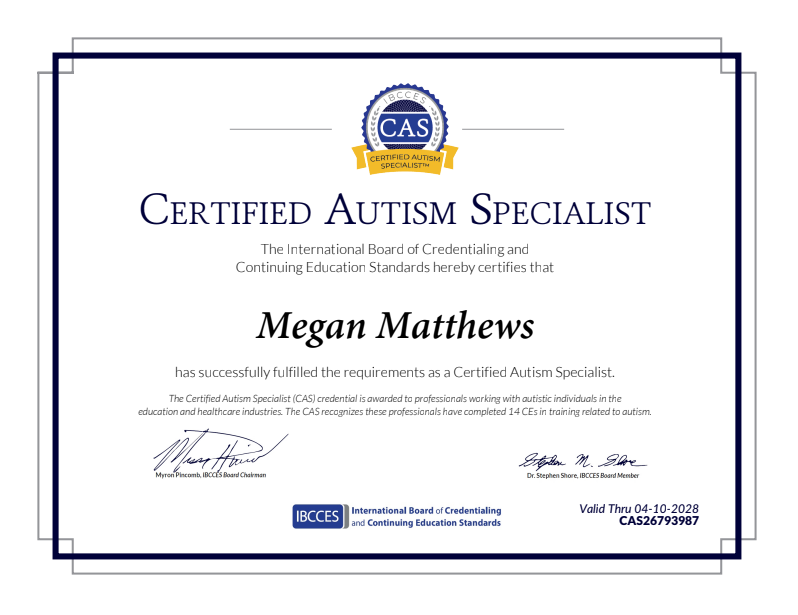
Icompleted my Certified Autism Specialist (CAS) credential, and I want to tell you why.
I've spent my career in pediatric OT, and a lot of my caseload has always been autistic kids. Kids who struggle with regulation, sensory overwhelm, big feelings, transitions, and the everyday stuff that makes daily life feel hard for the whole family. The work feels right to me. I love it.
But loving it isn't enough. I also want to be sharp.
Why I Did This
A few reasons, and I'll be honest about all of them.
The first is that I want to be evidence-based, validated, and current in how I work with autistic kids. Pediatric OT programs cover autism, but they don't go deep on it. I've been picking up specialized knowledge over years of practice. I wanted formal, structured training to back up what I've learned on the job. I wanted to be sure I was doing it well, not just doing it.
The second is that I'm naturally good at the relational side of this work. I'm good at being on the floor, being playful, meeting kids where they are, and connecting with autistic children in particular. That's a strength I'm proud of. The CAS credential is about adding rigor and depth to that strength. Pairing the natural ability with the specialized education. The kids and families I serve deserve both.
The third reason is something I've watched happen for years in schools and preschools, and it's the part that probably motivates me most. I've worked alongside teachers and support staff who are doing their best with autistic students and feel completely overwhelmed. Not because they don't care. They care a lot. But they haven't been given the training to understand what's actually happening for these kids, or what to do about it.
I want to be part of the solution to that. I want to be the OT a school can call when they need help. I want to run training sessions for staff who are burning out trying to support autistic students without enough information. I want to bridge what we know about autism in clinical settings with what's possible inside a classroom.
The CAS credential gives me a foundation to do that with credibility.
What CAS is
Certified Autism Specialist is a credential offered through IBCCES, the International Board of Credentialing and Continuing Education Standards. It's a structured certification that requires graduate-level training in autism-specific content, continuing education, and a competency exam. It's recognized across healthcare, education, and therapy fields.
It is not a license. I'm already a licensed Doctor of Occupational Therapy in New York State, and that's the credential that lets me practice. The CAS sits on top of that. It's a specialty certification that says I've gone deeper into autism-specific best practices.
What this changes for the families I work with
For my private practice clients, it deepens what I bring. The way I already work, neurodiversity-affirming, parent-coaching, regulation and sensory focused, isn't going to change. The CAS coursework is sharpening it.
A few things will be more visible. I'll be more confident in the language I use to explain what's happening for your child. The “why” behind a behavior, the regulatory picture, the way different sensory profiles show up in different settings. I want to be able to teach you that in a way that clicks.
I'll also be a stronger resource for school-related questions. If your child has an IEP or a 504, or you're trying to figure out what to ask for, I'll have a clearer picture of what good autism support looks like in those settings.
Down the road, I'm planning to start offering autism specialist consultations to schools and preschools in the CNY area. That means staff trainings, classroom support, and helping teams build environments where autistic kids can participate and learn. If you're a school administrator or a teacher reading this, I'd love to talk.
What it doesn't change
It doesn't change my philosophy. I'm not going to start using compliance-based approaches or push kids toward “looking typical.” That's not what neurodiversity-affirming practice is about. The CAS doesn't require any of that, and the parts of the curriculum I'm most excited about are aligned with how I already think.
It also doesn't change my pricing or my model. I still work with families one at a time, in homes, with parents at the center. That's still the practice.
One last thing
If you're a parent of an autistic child reading this and wondering whether any of this matters to you, here's what I'd say. Credentials are useful, but they're not the thing that changes outcomes for your child. The thing that changes outcomes is whether you have a clinician who actually knows your kid, listens to you, and gives you strategies that fit your real life.
I've been doing that work since long before I started CAS coursework, and I'll keep doing it. The credential is one more piece of evidence that I take this work seriously, and that I'm committed to staying sharp at it.